

Ethics Is the Infrastructure
Why the Future of AI Will Be Decided by Values

There’s a growing conversation happening around artificial intelligence that feels both urgent and incomplete. Much of the public discourse centers on capability: how fast AI is advancing, how much productivity it can unlock, and how quickly companies must adopt it to remain competitive. But beneath all the excitement lies a increasingly important question—one that will likely define the future of this technology far more than speed or scale:
What values are being embedded into these systems as they evolve?
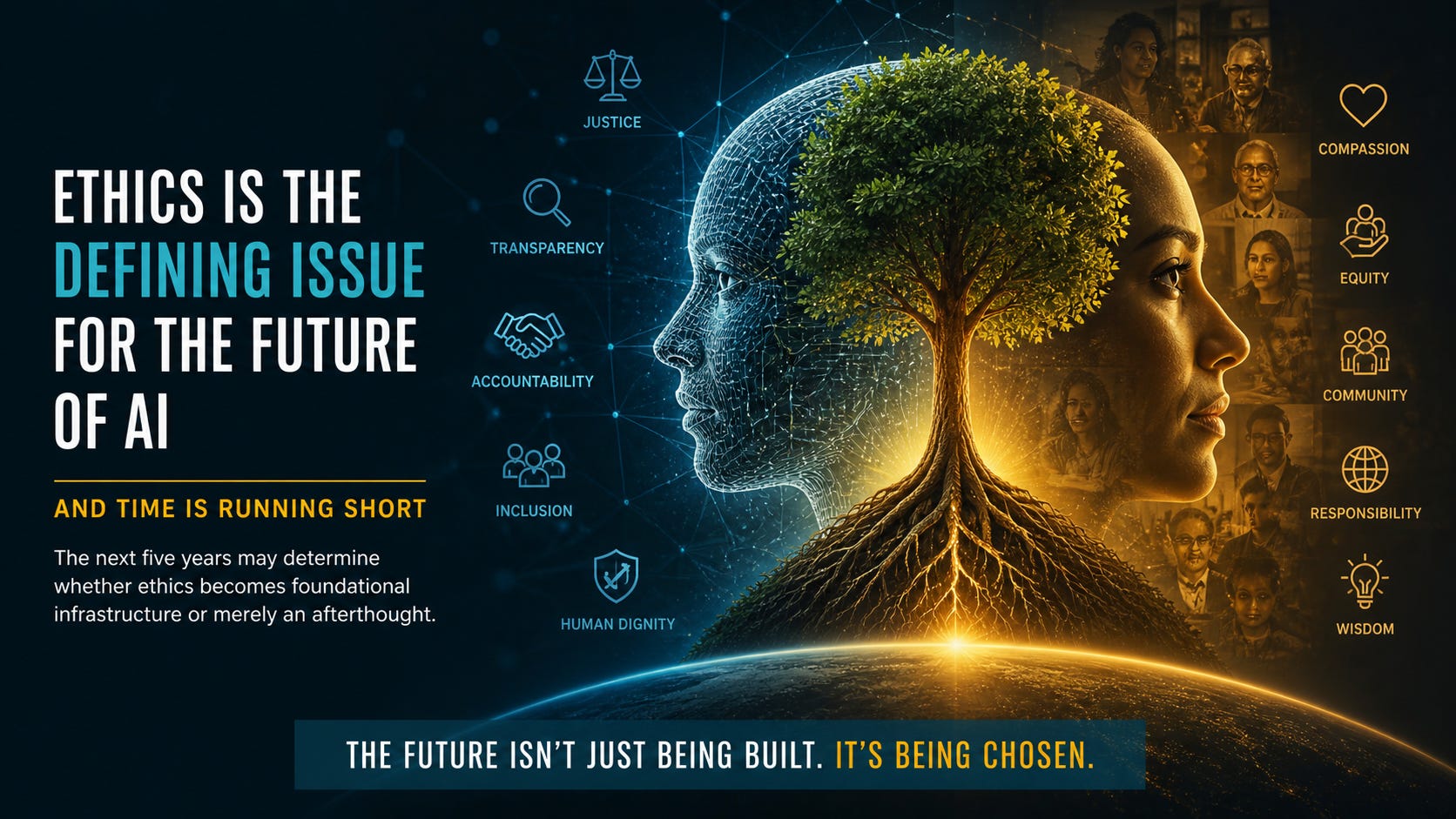
A recent article from the University of Virginia Darden School of Business argues that ethics is becoming the defining issue for the future of AI, warning that the next several years may determine whether ethical considerations become foundational infrastructure or merely an afterthought. (news.darden.virginia.edu)
That framing resonates deeply because technology never develops in isolation. Every system we create inherits the assumptions, priorities, blind spots, and incentives of the people and institutions building it. AI is no different. If existing systems already produce disparities in access, opportunity, representation, and capital allocation, then AI trained on those systems risks not only reflecting those inequities, but accelerating them at unprecedented scale.
This is why ethics cannot be treated as a compliance exercise or public relations strategy. It must become part of the architecture itself.
During a conversation at One Planet Summit, Dr. Joy DeGruy offered a powerful reminder: “Every system is perfectly designed to get the results it achieves.” That insight feels especially relevant in this moment. We often speak about technological harm as though it were accidental, but systems tend to reproduce the logic on which they were built. If we fail to interrogate those foundations now, we risk automating historical inequities into the next era of society.
The Darden article highlights concerns already emerging within AI ecosystems—bias, opacity, concentration of power, and the widening gap between technological advancement and governance. But what strikes me most is not simply the existence of these risks. It’s how often ethics is still positioned as secondary to growth, efficiency, or market dominance.
We’ve seen this pattern before across industries. Innovation moves quickly. Reflection comes later. Repair becomes exponentially more expensive.
The difference with AI is the sheer velocity and scale.
The question is no longer whether AI will transform society. It already is. The deeper question is whether we are building systems rooted in dignity, transparency, accountability, and shared humanity—or whether we are embedding old inequities into entirely new infrastructure.
One of the core ideas I explore in Enlightened Bottom Line is that systems ultimately mirror consciousness. What we normalize becomes encoded. What we reward becomes reinforced. What we ignore compounds over time. AI, in many ways, is not just a technological tool; it is a reflection of collective values.
That is why ethical AI cannot be shaped by technologists alone. It requires philosophers, educators, social scientists, policymakers, artists, ethicists, and community leaders at the table alongside engineers and investors. Most importantly, it requires the perspectives of those historically excluded from systems of power and decision-making—not as symbolic participants, but as true co-creators.
Because inclusion is not about optics. It is about perspective. And perspective shapes outcomes.
The Darden article notes that many of the frameworks for ethical AI already exist; the challenge is implementation. That observation feels profoundly important. Humanity is not suffering from a lack of awareness as much as a lack of alignment between values and incentives.
We already know transparency matters. We know concentrated power creates risk. We know biased training data produces biased outcomes. We know accountability matters. Yet knowing and operationalizing are very different things.
This is where leadership becomes critical.
Businesses are not neutral observers in the AI revolution. They are actively shaping the norms, architectures, and economic systems future generations will inherit. The organizations that lead responsibly in this era will not simply be the ones that move fastest. They will be the ones willing to ask harder questions about the long-term societal impact of what they are building.
In many ways, ethics itself is becoming a form of infrastructure.
The companies that understand this will recognize that ethics is not friction to innovation—it is what makes sustainable innovation possible. Ethical systems create trust. Transparency deepens resilience. Accountability creates legitimacy. Without those elements, even the most advanced technologies will struggle to maintain public confidence over time.
Ultimately, the future of AI will not be decided by computation alone. It will be shaped by the moral imagination of the people building it and the courage of leaders willing to align innovation with humanity’s highest values rather than its oldest patterns.
The window to shape that future is narrowing. The decisions being made today—in boardrooms, labs, classrooms, and investment committees—will reverberate for generations.
The real question is whether we are building systems that merely optimize the world as it exists, or systems capable of helping humanity become what it still has the potential to be.
I would love to know your thoughts in the poll below and if you want to participate in a cohort experience around the Enlightened Bottom Line please email me at jenna@jenna-nicholas.com
You can see my upcoming events below:

Jenna is the President of LightPost Capital, an investment and acquisition firm. She is an active angel investor and has invested in over 3 unicorns. She is also the CEO of Impact Experience.
In her groundbreaking book, Enlightened Bottom Line, Jenna Nicholas explores the powerful intersection of spirituality, business, and investing—an intersection too often overlooked in a world driven by profit alone. Drawing on moving stories of entrepreneurs, investors, and leaders who are living out this integration, along with cutting-edge research, Nicholas reveals how spiritual wisdom can guide ethical choices in finance and business.
Please consider supporting my work on Substack. As a paid subscriber you will receive a free book, access to the archive and other perks.
Hi Jenna- thank you so much for this lovely article. I have one question- sometimes I feel like we need good alternatives for consumers to choose from. Right now, to your point, I think we have a list of bad options.
Do you think the answer is actually funding alternative models we can work from? Is it…consumers being more vocal about these things?
What can we, as individuals, do about it? (Asking for a friend :D)
I’m also asking because I used to work at an AI company and…it’s just a whole other world. I think AI is one of the first technologies that started consumer first, and maybe we as consumers then need to demand alternatives also.
Thank you Jenna for this thought provoking article. I have been trying to articulate the need for encoding ethics into AI as part of the infrastructure as technology evolves at such a fast pace and making sure that we in include the voices of people who have been historically excluded at the table. This article captures my thoughts. I look forward to reading your book.