

Empathy Is Not Soft.
It’s Infrastructure.

“Forces beyond your control can take away everything you possess except one thing, your freedom to choose how you will respond to the situation.” — Viktor E. Frankl
Lately, I’ve been thinking deeply about what holds organizations, communities, and even civilizations together during periods of profound disruption.
We are living through an era defined by contradiction. Extraordinary technological advancement exists alongside widening inequality. Hyperconnectivity coexists with loneliness. Capital markets continue to expand while trust in institutions contracts. Everywhere we look, we can feel both acceleration and fragmentation happening simultaneously.
And yet, amid this turbulence, I believe something else is emerging too: a growing recognition that empathy is not peripheral to leadership, investing, or business. It is foundational to all three.
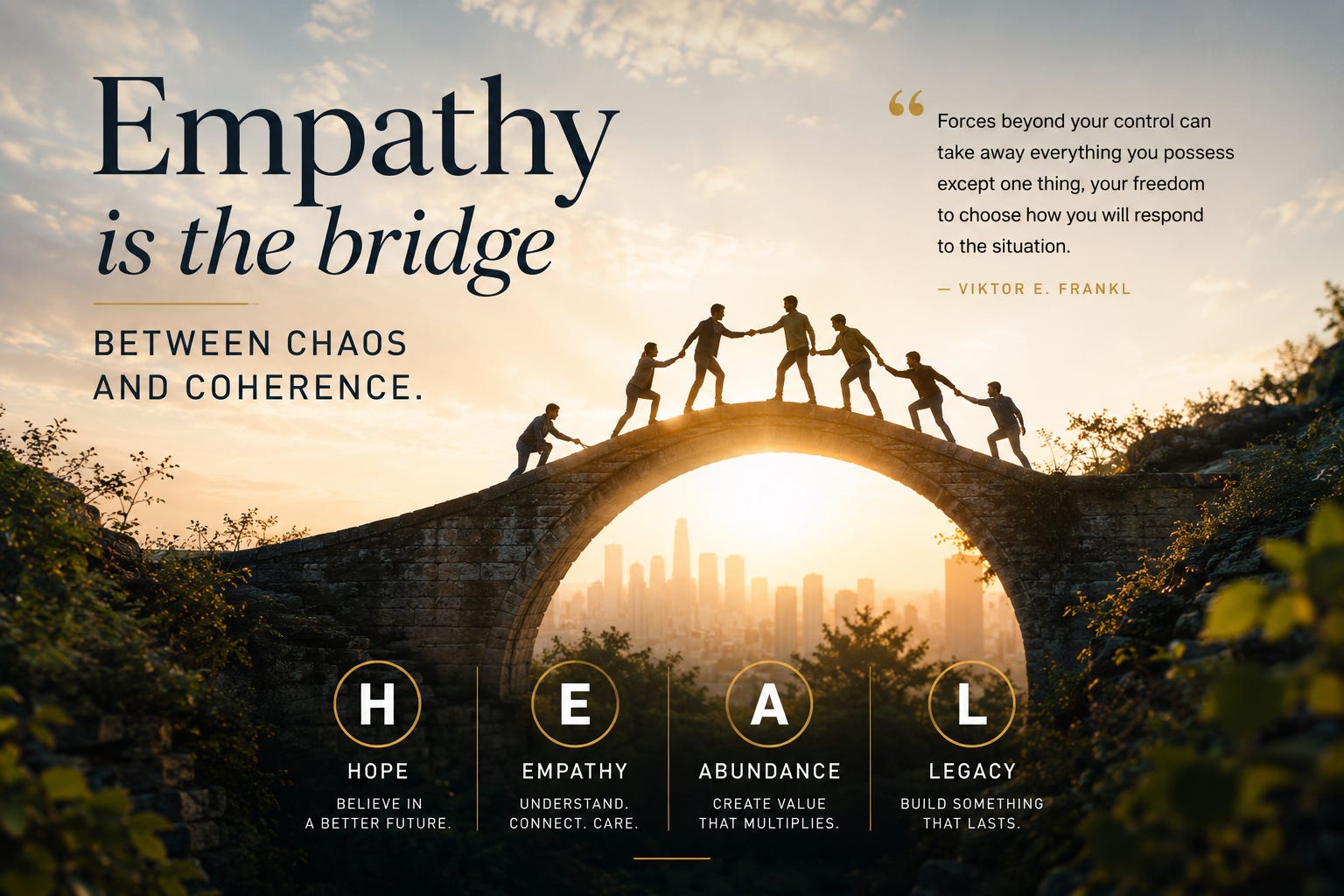
Without empathy, organizations lose coherence.
Without coherence, teams fracture.
Without trust, systems eventually fail.
What struck me most while reflecting on these themes is that the greatest businesses and leaders today are not simply optimizing for growth. They are optimizing for alignment — between purpose and profit, values and operations, people and systems.
This is where empathy becomes transformational.
Empathy allows us to move beyond transactional relationships and into relational ecosystems. It enables leaders to recognize the humanity behind performance metrics. It creates the psychological safety necessary for innovation, creativity, resilience, and honest communication.
And perhaps most importantly, empathy creates belonging.
That sense of belonging may ultimately become one of the defining competitive advantages of the next generation of organizations.
I’ve seen this firsthand in conversations with founders, investors, and executives who are intentionally building cultures rooted in transparency, emotional intelligence, and shared purpose.
One story that stayed with me came from Julian MacQueen of Innisfree Hotels, who introduced the idea of “checking paranoid fantasies.” The concept is simple but profound: instead of allowing assumptions, anxieties, or unspoken tensions to silently erode trust, employees are encouraged to communicate directly and compassionately.
That practice may sound small, but it represents something much larger.
It reflects a shift from fear-based organizational dynamics toward trust-based systems.
It reflects the understanding that healthy communication is not ancillary to performance — it is performance infrastructure.
The same is true for feedback loops, values alignment, and consistent communication. Organizations that thrive in complexity are not necessarily the ones with the most resources. Often, they are the ones with the greatest coherence between their mission, culture, leadership, and decision-making.
This matters especially now because we are simultaneously experiencing forces of disintegration and integration. On one side, we see polarization, extraction, burnout, environmental degradation, and deepening inequities. On the other, we see growing movements around sustainability, conscious capitalism, stakeholder governance, mental wellness, and impact investing.
The question is not whether transformation is happening.
The question is what kind of transformation we are participating in.
For me, one of the most powerful ideas emerging today is that business itself can become a vehicle for collective healing and human flourishing. Not through performative branding, but through genuine structural alignment between economic systems and human values.
That alignment requires courage.
It requires leaders willing to prioritize long-term trust over short-term extraction.
It requires investors willing to redefine returns more holistically.
It requires organizations willing to examine whether their internal cultures actually reflect the values they publicly promote.
And it requires all of us to reconnect with the deeper “why” beneath our work.
Simon Sinek famously wrote about the importance of starting with why. But increasingly, I believe the challenge is not simply discovering purpose — it is operationalizing purpose coherently across every layer of an organization.
Purpose cannot live only in mission statements.
It must exist in hiring practices.
In compensation structures.
In leadership behavior.
In how conflict is handled.
In how people are treated when they fail.
In whether employees feel psychologically safe enough to tell the truth.
That is where empathy becomes tangible.
A Few Reflections I’m Carrying Forward
Empathy is not weakness. It is strategic clarity rooted in human understanding.
Coherence matters more than optics. Alignment between values and actions builds trust.
Culture is not accidental. It is intentionally designed through daily behaviors and systems.
Presence is leadership. The ability to truly listen may become one of the rarest skills in modern business.
Purpose and profitability are no longer opposing forces. Increasingly, they reinforce one another.
Belonging may be one of the defining economic and organizational advantages of the future.
We are being invited to rethink what prosperity means.
Not simply accumulation.
Not simply scale.
But the creation of systems that allow people, communities, and organizations to thrive together.
And perhaps that journey begins with something deceptively simple:
Choosing empathy — especially in moments when fear, division, and disconnection would be easier.
Jenna
Please fill out the form below if you want to participate in a cohort focused on the Enlightened Bottom Line.
You can see my upcoming events below:

Jenna is the President of LightPost Capital, an investment and acquisition firm. She is an active angel investor and has invested in over 3 unicorns. She is also the CEO of Impact Experience.
In her groundbreaking book, Enlightened Bottom Line, Jenna Nicholas explores the powerful intersection of spirituality, business, and investing—an intersection too often overlooked in a world driven by profit alone. Drawing on moving stories of entrepreneurs, investors, and leaders who are living out this integration, along with cutting-edge research, Nicholas reveals how spiritual wisdom can guide ethical choices in finance and business.
Please consider supporting my work on Substack. As a paid subscriber you will receive a free book, access to the archive and other perks.
The best line in your post: 'it is operationalizing purpose coherently across every layer of an organization'. What a profound and simple understanding. I have bee struggling with how to articulate what the difference is between so many high minded company aspirations and why I feel Innisfree Hotels is different. When I ask companies I admire about the investment they make in executing their values, I rarely hear they have a person designated to execute the principles into action.
Really appreciate these reflections here Julian and your important work in this area!